


![At a group practice, sophomore Layla Gutierrez sings, while seniors Armando Gutierrez and Jaden Cerna play the electric bass and guitar. “It’s cool being in a band with [my sister], but though we’re related, sometimes our ideas in the creative process differ and cause some conflicts,” Armando said. (@hopelesssamaritanband)](https://alisaltrojantribune.com/wp-content/uploads/2026/05/067cae3d6e7e8d0fd59cd886c8c689dbc703ed15-14-1033x1200.jpg)











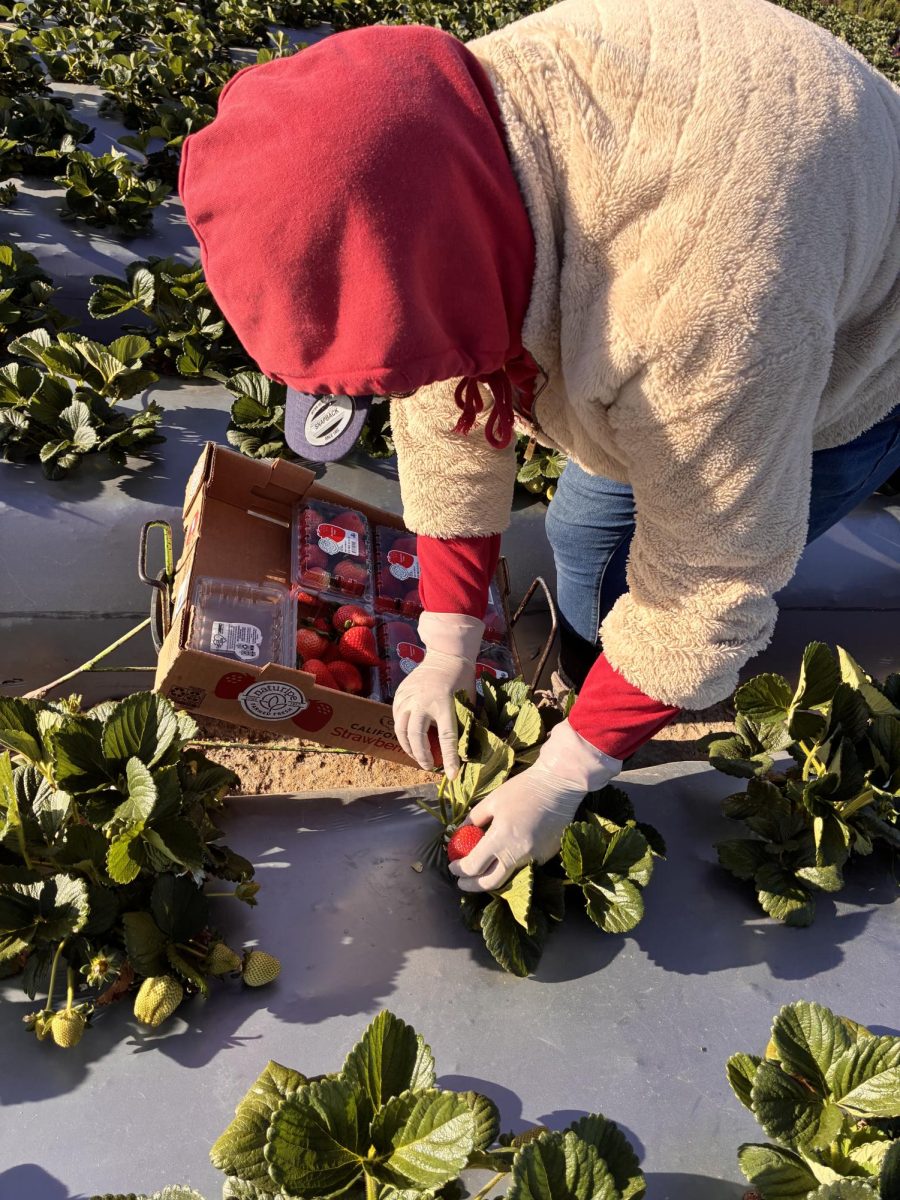
Working in the fields is an intense, physically demanding job that requires you to be bent down from the waist to pick strawberries and pack them into a box.
Most of the workers are Mexican immigrants whose only choice is to work in the fields. Not only that, it is a seasonal job, which means there are months where many parents are left without work and having to move from place to place to put food on the table.
Field workers should get more credit because they pick our fruits and vegetables before the world wakes up, just to be paid $2.50 per box or $16.50 per hour.
Workers start off their day before sunrise, moving down long rows of plants to pick ripe berries by hand and end their day by sunset. The berries must be picked at a specific time to make sure that they don’t spoil.
The job requires constant bending, quick movement, hand-to-eye coordination, and attention to detail to ensure no bruising on the strawberries. But there are consequences to this demanding job. Many workers experience chronic pain in their backs, hips, and legs.
My experience began when my parents asked me to help them out with money because we were behind on our bills. During sophomore year, my parents were struggling to make ends meet, to the point where they had to borrow money from relatives.
Initially, I had agreed to help them out because it was at our lowest point. I had done it to help them out, but I also had plans to attend college and I needed to save money for tuition.
Although I had no job experience, I was determined to show up and do my best to help out.
I didn’t begin as a picker, but as a zacatera. A zacatera is someone who cuts guia, which is overgrown weed, around the plants. It is important to remove the guia because it steals the natural nutrients from the berries and lowers berry growth.
I arrived at the strawberry fields around 5:25 AM and introduced myself to the supervisor. Immediately, I was given a sickle and sack that I tied around my hips. I was instructed to cut every piece of guia from both sides of the furrow.
I thought, “Okay, this can’t be that hard to do,” but I was wrong.
I bent down and began to cut the guia. I kept going until I was ¾ into the row when my back began to hurt. When I felt that small pain, I immediately stood up to give my back a rest and kept doing it until I got to the end of the furrow.
I remember being told off by my supervisor, telling me that I shouldn’t stand up all the time because it would make the pain worse.
I continued working, trying to ignore the pain until it was break time. I kept asking myself if I even wanted to continue working because I never realized how intense it was.
Honestly, I kept giving it a chance and still kept showing up because it taught me how to value hard work. We don’t know what it’s really like to work in the fields until you experience it yourself or hear stories from our workers.
I enjoyed it, not the pain, but because it taught me what hard work was like and I built a good relationship with my coworkers that I was given a nickname, La Pequeña, the little one, since I was the youngest worker.
There were some days where we helped the pickers pick berries with buckets. I got a bit of practice on how to know which berries are good and how to pack. By the end of 2 months, I earned around $4,000.
When summer rolled again, I knew that I wanted to work again. I was thinking about going to cut weeds again but this time, I decided to give picking a chance.
I wasn’t really excited for it because I knew that it required more skills to pick berries but I decided to do it anyway.
I would wake up at 5:30 and leave the house by 6:00 because we started work at 6:30. Once there, I would grab a card with numbers on it, my carrito, and a box. We would all wait around until it was time.
Once the supervisor would tell us it was time already, I would “grab” a furrow and run towards the other end of it. I would place down my carrito and lay down my box at a 90 degree angle.
Going plant by plant, I would grab good berries and put them inside the basket and throw away the “juice” which is the small berries.
Once I would fill up the 8 baskets, I would put it on my shoulder, run towards the truck and turn it in for inspection.
When the checkers saw my baskets were good, I would give them my card for them to punch it. I was easily able to fill the baskets because the berries were good, but I couldn’t move fast enough and you don’t get help from anyone.
We were being paid by contract, which means that we got paid by the box we made. So if you made 40 boxes, you had secured $100. Honestly, It was a bigger difference than cutting weeds.
As the youngest, I was often teased, told that “I shouldn’t be tired or feel any pain because I was young,” or “When I was your age, I would never get tired.” As the day wore on, I began to move slower from the pain and the heat.
The heat is what got to me the most. My mouth was so dry and it’s not like I could just leave the furrow to drink water. I mean you can, but people generally don’t when “grabbing” a furrow because people will steal the berries.
I continued moving, trying my best to keep up with the other workers and not be left behind.
Slowly but surely, I got better at it, but one of the things I couldn’t ignore was the pain. There were some days where I was able to work comfortably, but there were days where my body would give up even before doing 15 boxes.
If the berries were good, I would do a good 50 boxes, but if it was low and bad quality, I would do 30 boxes. I earned roughly $5,500-$6,000 in just two months of picking.
One of the things that I learned during my work experience was how to value hard work. As a little girl, I’ve always thought that my parents had an easy job. But once I had experienced it myself, I found out just how physically demanding it is.
It made me be more appreciative towards my parents because of the sacrifices and hard work they have done so I can have a better future.
This experience has made me realize how overlooked our workers are. Working in the fields is seen as an “easy” job to many people out there. But a lot of people don’t know how much skill, patience, and endurance it takes to pick fruits and vegetables.
From picking to long hours under the sun, it takes effort to keep production going. If more people understand that, they might think twice before overlooking our workers who help put food on their table everyday.
Sofia Barajas • Apr 24, 2026 at 2:13 pm
Okay fax my favorite reporter.
Sofia Barajas • Apr 24, 2026 at 11:34 am
YESS CECI!!!