

![At a group practice, sophomore Layla Gutierrez sings, while seniors Armando Gutierrez and Jaden Cerna play the electric bass and guitar. “It’s cool being in a band with [my sister], but though we’re related, sometimes our ideas in the creative process differ and cause some conflicts,” Armando said. (@hopelesssamaritanband)](https://alisaltrojantribune.com/wp-content/uploads/2026/05/067cae3d6e7e8d0fd59cd886c8c689dbc703ed15-14-1033x1200.jpg)












Since the introduction of systems like ChatGPT, AI has become increasingly common in education, as both students and teachers integrate these tools into their routines, the landscape of teaching and learning is shifting.
Whether one thinks a teacher should or should not use AI, it’s important to call attention to how the district will move forward with its AI policies and what that means for teachers and students at Alisal.
“I’ve been aware that there has been a lot more usage by teachers,” senior Leonel Osorio said. ”But I wouldn’t mind them using AI as long as they don’t solely rely on it to do their work, more like an assistant rather than trying to remove assignments that can help us learn.”
According to Gallup.com, Three in 10 Teachers Use AI Weekly, Saving Six Weeks a Year, in the 2024-25 school year, six in 10 teachers reported using an AI tool for their work, and in an informal survey of Alisal teachers asking if they used AI in their work, 55% said they do.
The survey showed that ChatGPT, Magic School AI, and Diffit were the most common software being used by educators at Alisal. They use these tools for generating questions, lesson plans, assignments, worksheets, quizzes, learning material, reviewing, and grading.
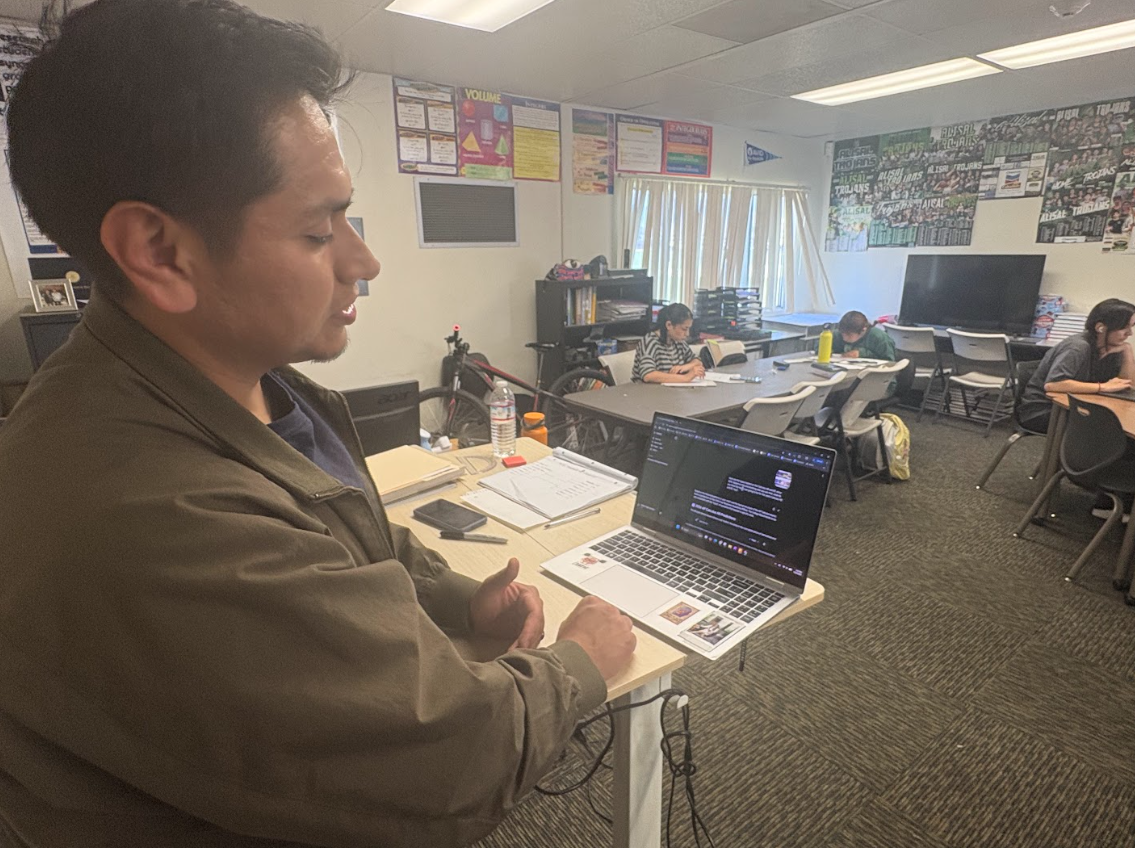
Teachers use AI in their classrooms for grading assessments, generating lesson plans, quizzes, worksheets, creating personalized learning materials, and other resources to assist students. “I don’t use AI daily, but I do sometimes use it for my literature class to generate images and give a visual aid,” AP Spanish teacher Juan Torres said. “I also use it to transfer quizzes from one format and platform to a different one. For example, I use some PDFs on the computer, and I used this program called Get Marked, and had it make a Google form by uploading the PDF to it.”
While teachers like the idea of helping both themselves and the students, they are cautious. “I think it’s a really good tool if you use it accordingly and don’t over rely on it,” math teacher Hector Rojas said. “I have used it to make different copies of tests, but it still makes errors, so I have to always double check its product and fix the formatting.”
Rojas said students can use it to learn how to solve problems, learn concepts, and generate practice problems, but teachers have to emphasize to students that learning is the most important part. “There will always be students who use it to just finish an assignment since students cheated before AI, so it’ll be a problem that never goes away,” he said. “But those who prioritize learning will benefit tremendously, and I have even used it to get an explanation to a problem, and it feels like you’re getting one on one help.”
According to the NIH, the research finds that the usage of AI in teaching significantly enhances students’ creativity, with learning engagement playing a mediating role in this process, thereby promoting creativity improvement.
While AI can be very beneficial for students and teachers, there are still a few concerns raised about the topic. “I worry that we as teachers won’t do our due diligence and compare the scores that AI has given out for our students and look at them to see if that matches what we feel as an accurate score for our students,” government and economics teacher Jenness Kelly said.
“You already have people undervaluing teaching in general and so this is just another way to undermine teachers and move on towards more automation,” English teacher Mick Battaglini said. “And some people might say, ‘Well why do we even need them [teachers] when we can have computers and AI teach students?’ and I just don’t see it as a good thing.”
Senior Brandon Reyes also shared a similar sentiment. “It shouldn’t be used to replace a teacher’s job since it really can’t be replaced, and AI cannot replicate what they can do,” he said.
“One problem with AI in general is that AI is embedded in Google, and since it’s one of the top systems out there, if you want to use Google’s software you have to have AI on, and while there may be other options like Safari and duckduckgo, they don’t have nearly the same services and connections to business, and it’s forcing everyone to not have that choice,” English 11 Course Lead Jared Hart said.
Hart said the district gave teachers the option to let AI grade the district assessments for a trial run. “I graded it [the district assessment] myself and asked it to grade it with my rubric,” he said. “So I got to see a direct side by side comparison of how it was grading and there was a 20% difference in the grade, so the average grade that I would score was around 70% and it was giving 90% and so I came to the conclusion that it just doesn’t have the right human understanding in logic that we do in grading, and so that’s what English teachers realized about AI, it’s a machine that just does not understand our language.”
These concerns are very reasonable and since AI will likely never truly go away, there needs to be safeguards and regulations put in place, which is where the District’s AI committee falls into place.
“The AI committee/work group, was formed pretty much after ChatGPT hit the scene, and ever since then we have done trainings and made policies, and right now our main goal is really kind of keeping up with trends and making sure that we have our policies, guidebooks, and trainings out there,” District E.D tech Amber Dodd said.
Dodd said the district doesn’t have a student facing AI program, but there are some caveats because there are some programs that do have student facing stuff already. “But one of the reasons that we haven’t had Gemini for teens turned on is because we’re really looking at all the safeguards that come with it,” she said. “And while there can be a lot of benefits we also want to make sure that we are protecting the learning environment.”
According to Dodd, she said the AI committee is trying hard with their policies to have teachers, directors, and librarians in mind. “One thing that our [the teachers] union contract language has been like really specific for is that it won’t take away our job security, so the district is not going to hire AI instead of teachers to do the work, and while there might be job components that change, I think those will also be heavily involved with a committee or work group for input before anything gets put in for that [change],” she said.
For students or parents interested in learning more about the AI policies, or simply the Ed Tech Team, they can go to the website. The website offers several resources such as contact information, information on what the team’s plan is going forward, and how the trainings are made.
“It’d probably be a little boring for students to go there, but it’s where all of our stuff is and it’s a public site, so you guys can go there if you want to learn more about all of our AI work or see any of the trainings that we’ve done for teachers or that we have done for staff,” Dodd said.