

![At a group practice, sophomore Layla Gutierrez sings, while seniors Armando Gutierrez and Jaden Cerna play the electric bass and guitar. “It’s cool being in a band with [my sister], but though we’re related, sometimes our ideas in the creative process differ and cause some conflicts,” Armando said. (@hopelesssamaritanband)](https://alisaltrojantribune.com/wp-content/uploads/2026/05/067cae3d6e7e8d0fd59cd886c8c689dbc703ed15-14-1033x1200.jpg)


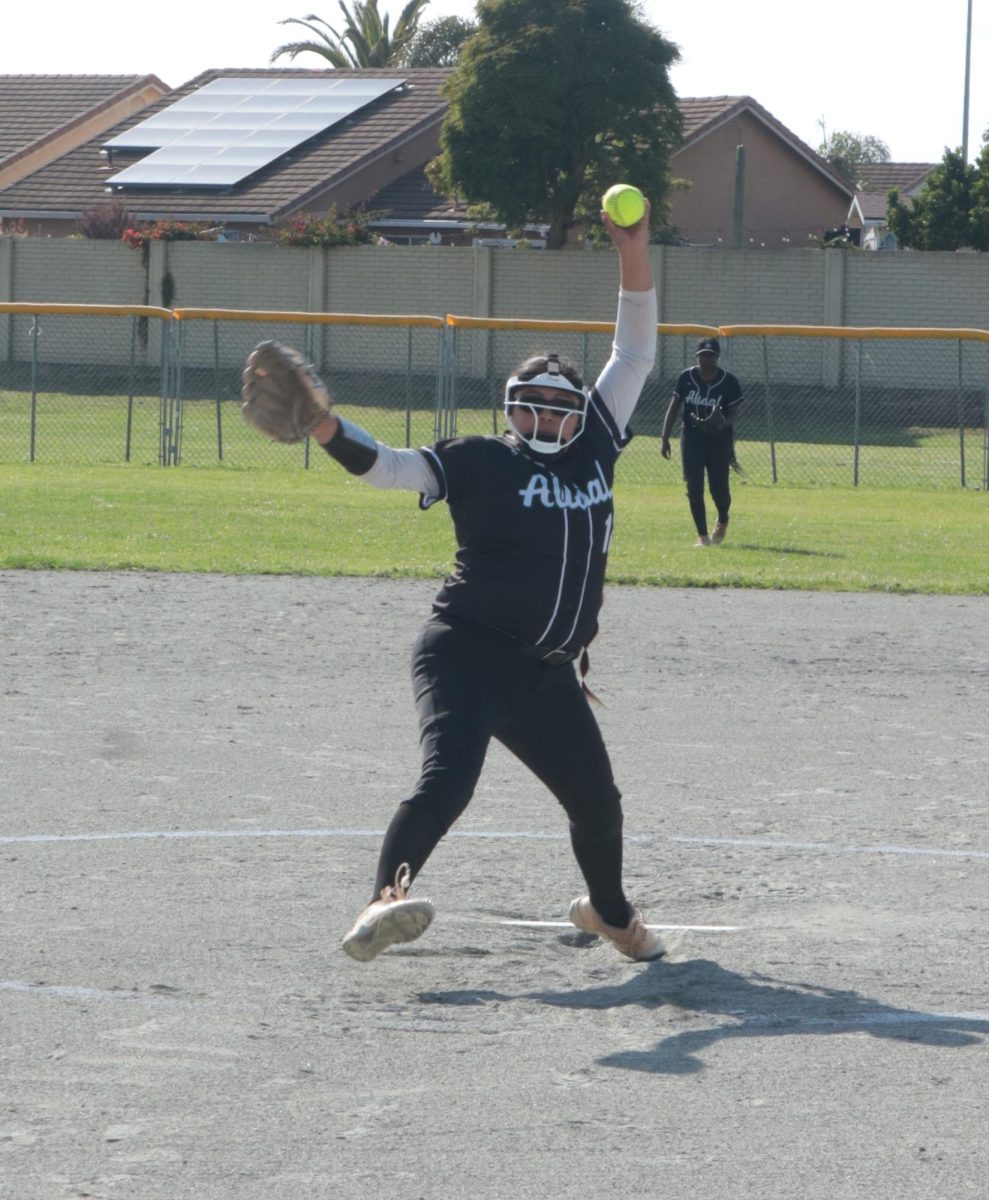












In honor of Alisal’s 60th Anniversary, this is the sixth in an ongoing series of staff/alumni profiles.
Social Studies teacher Gloria Estrada was born in Salinas, as a migrant student. Her father worked in the lettuce fields and her mother worked in the strawberry fields. Between the 12 months, Estrada’s parents would work for 6 months until the season was over and would go back to Texas with the rest of her family.
While at Alisal, she joined volleyball during her junior year and was part of Movimiento Estudiantil Chicanx de Aztlán (MECHA). MECHA is a group of high school and college students that came out of the civil rights movement, Chicano Movement, coming together to address some of the inequities in society. ¨Here at Alisal, we did Dia de la Raza,” Estrada said. ¨With high school kids, we organized workshops for the whole community and we did a ceremony to welcome everyone.¨
Being a student at Alisal, she saw how compassionate the teachers were towards the students and how much they actually cared about the students. “At that time, I really liked how much teachers cared for us and looked after our grades,¨ Estrada said. She saw how many students got into conflict with teachers and that made her realize that there was a need for compassion.
Her interest in becoming a teacher began when she would go to work with her aunt, a teacher’s aid, and her uncle, a principal, at Bardin Elementary. “I really enjoyed the kind of work that they did as a principal and teacher’s aid,” she said. Because of the environment that she was exposed in, she had decided to become a principal and asked her uncle how to become a principal. “He said, ‘Well you have to become a teacher first and you gotta go to college.’ And so that’s how I decided to become a teacher, so I could become a principal.”
She graduated in 1994 and went to Santa Clara University, where she majored in History, Ethnic Studies, and Spanish, and got her Bachelor’s degree. She got her first Master’s degree at Harvard University and second Master’s degree at San Jose State.
While at Harvard, Estrada was in the school of education, Risk and Prevention Graduate Program, which was a combination of psychology and education. “I was interested in learning more about the conditions in schools for some students succeeding (graduating and going onto to post secondary education) and some students struggling and dropping out,” she said.
When Estrada came to Alisal, she started off as a full-time summer school teacher in Remedial English. “I was 22 and my seniors were 18, so only 4 years apart,” she said. “So it was really weird.”
Working with teachers that were once her teachers was also a weird experience, since she had started off her career at a young age. She received support from Ms. Cabrera and former Principal Candy McCarthy to make that transition from student to teacher. “Ms. Cabrera was the biggest support because we were both in the social studies department,” she said. “The principal we had, my first year, teaching was Candy McCarthy and she helped me adjust and she would talk to me about what to do.”
After teaching for a total of 11 years, she worked with a team of teachers to create the job of Instructional Coach. “It was a lot of fun to be part of something new and something that was meant to support teachers with their professional goals,” she said.
She became an Instructional Coach because she was an English Learner (EL) Specialist and was expected to coach teachers at her school, but saw there wasn’t a guide to do so. Estrada and her team of coaches created a system and protocol to support them and help them coach other teachers. “When I was in it, it was the first time I created a job,” she said. “So it was very exciting to help build what the job is.”
In 2013, she became an Assistant Principal at Salinas High, Washington Middle School, Harden Middle School, and ROP. “What I liked the most was making some decisions at the schools, fixing things and making plans with people to make the schools better or meet the students’ needs,” she said. “What I didn’t like, and part of the reason I came back to the classroom was I was suspending and expelling a lot of students.” She realized that this was something she didn’t want to do because she wanted to help the schools and kids, and not kick them out. “It wasn’t right for me anymore,’ she said. “I did it for ten years, so I kinda got tired too.”
When she decided that she didn’t want to be an Assistant Principal in 2021, she came back to Alisal and asked former Principal Ernesto Garcia what was available in social studies, which was ethnic studies. “I like Ethnic Studies,” she said. “But I never taught it because it was a new class, so that’s how I got into it.”
Ethnic studies is all about learning experiences, cultures, and history of racial and ethnic minority groups. It is a class where we get to know more about the oppression, racism, and exclusionary practices that a minority group goes through and finds a way to fight it off. “Here at Alisal it needs to be taught because the majority of our students are part of marginalized groups and society in the United States,” Ethnic Studies teacher Gloria Estrada said.
Now that she has come back to Alisal, she has seen many improvements compared to her years here. “There are so many people in the school and in the community that really care about our school,” she said. “And I feel like there is a big sense of community, where people care for each other.”